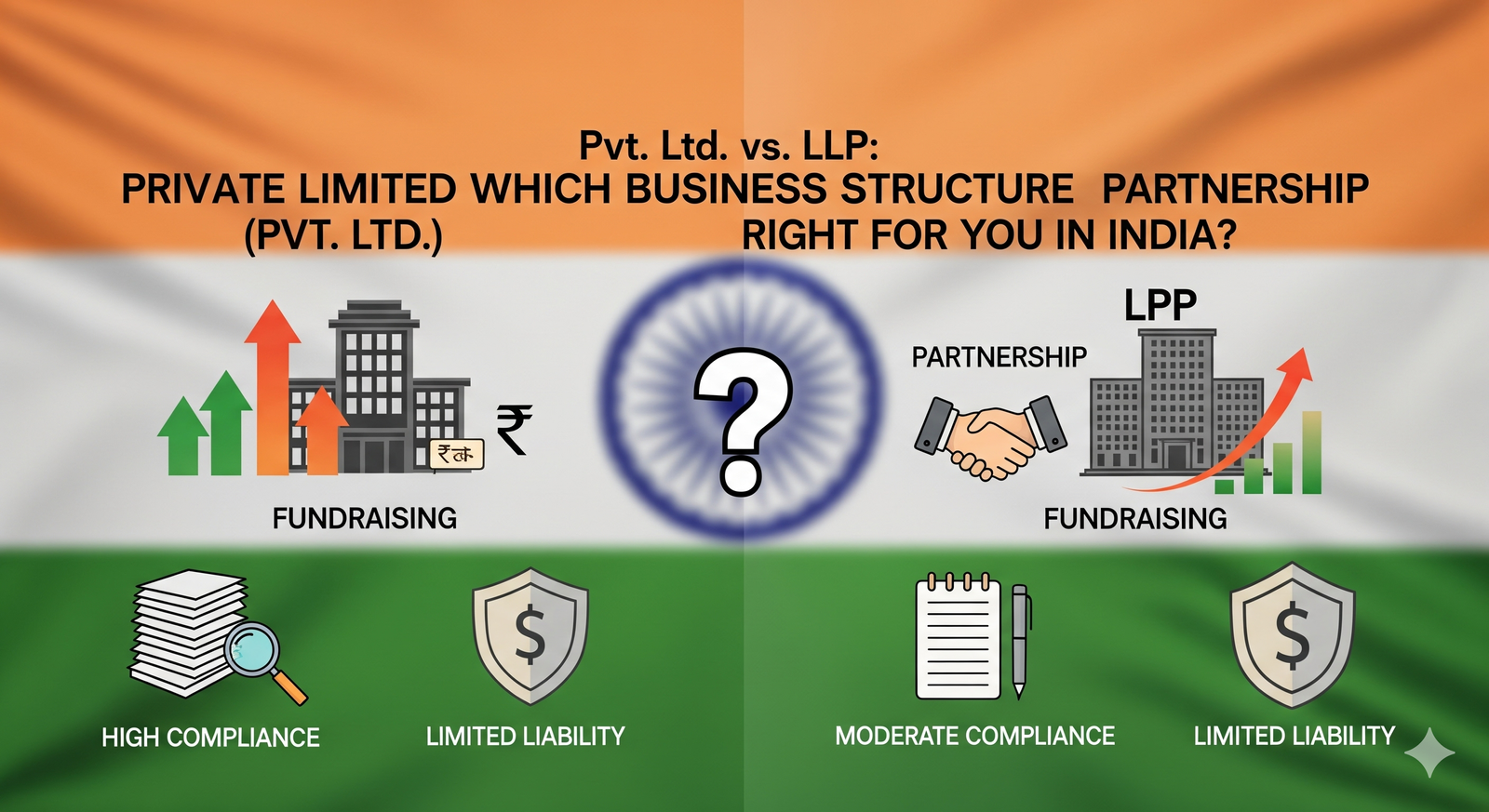
Choosing the right legal structure is one of the most important decisions you'll make when starting your business. In India, the two most popular choices for startups are the Private Limited Company (Pvt. Ltd.) and the Limited Liability Partnership (LLP). Let's compare them.
Private Limited Company (Pvt. Ltd.)
* Liability: Offers limited liability to its shareholders. Personal assets are protected.
* Fundraising: The preferred structure for venture capitalists and angel investors, as it allows for easy equity issuance.
* Compliance: Higher compliance requirements, including mandatory board meetings, statutory audits, and filings with the Registrar of Companies (RoC).
* Credibility: Generally perceived as more credible and stable by clients and investors.
Limited Liability Partnership (LLP)
* Liability: Partners have limited liability, similar to a Pvt. Ltd. company.
* Fundraising: Raising equity funding is more complex and less common compared to a Pvt. Ltd. structure.
* Compliance: Lower compliance burden and costs. For example, audits are only required if turnover exceeds ₹40 lakh or contribution exceeds ₹25 lakh.
* Flexibility: Offers more flexibility in its internal structure and management.
Which one is for you? If your goal is to raise equity funding and scale rapidly, a Private Limited Company is almost always the right choice. If you are starting a professional service firm with multiple partners and want operational flexibility with lower compliance costs, an LLP is an excellent option. Contact us at Rexera to discuss the best structure for your unique vision.
Pvt. Ltd. vs. LLP: Choosing the Right Business Structure in India
By Amit Albertbhai Rathod, Compliance Expert •